How to take class attendance on your phone
A practical guide to taking class attendance on your phone: why a class attendance app beats paper, and how to tie the register to class packs.

Taking attendance sounds like the most trivial job in a school. Someone reads out names, someone ticks a box, the class starts. And yet in most recurring-class schools the register is quietly broken — a clipboard that lives in one room, a notebook that lives in another, a memory that lives in the teacher's head until the end of the week. The cost of that mess isn't the two minutes it takes to call names. It's everything that depends on the register being right: pack balances, teacher pay, who actually showed up, and whether the student in front of you has already used today's class.
This guide is about taking attendance on your phone — not as a gimmick, but as the single action that keeps the rest of your operation honest. A good class attendance app does more than tick boxes; it decrements the right class pack, records who taught, and gives you a clean history you can trust at month-end. We'll cover why paper drifts, what to look for in a phone-based register, how to tie attendance to class packs, and the small habits that make it stick.
Why the paper register quietly fails#
A paper register works beautifully for your first dozen students. Then the term fills up. Two people cover reception on different days, a teacher swaps a class at the last minute, a drop-in turns up without a booking, and the clipboard starts telling small lies:
- Did this student already use today's session, or did someone just forget to tick it?
- The Tuesday teacher marked the sheet; the Thursday teacher used a fresh one. Which is right?
- A drop-in came in. Did anyone write it down, or is it lost?
- The sheet is in the studio, but the balances live on a laptop at the desk. When do they ever meet?
Each of these is a tiny leak. On its own it looks harmless — you wave the student through, you give them the benefit of the doubt, you'll fix it later. But multiply each small concession across a busy term with hundreds of attendances, and you get two compounding problems at once: students attending on credits they've already spent, and a register so unreliable that nobody trusts it enough to act on it.
The root issue is that paper has no idea what happened in the room. It only knows what someone remembered to write, usually hours later and often from memory. The register and the balance live in two different places, kept by two different people, and they drift apart the moment the school gets busy.
What "attendance on your phone" actually means#
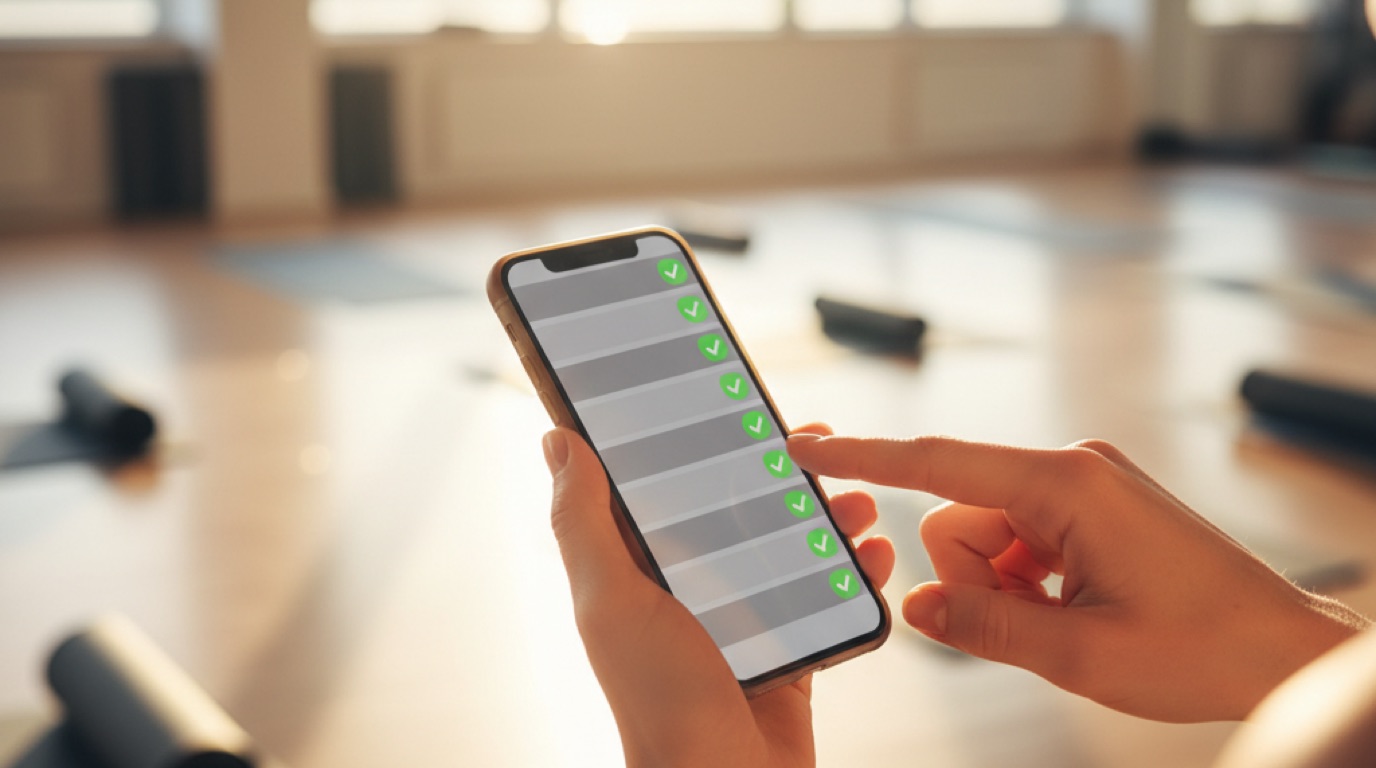
It does not mean photographing a paper sheet, or typing names into a notes app after class. A real class attendance app puts the live roster for this class, on this date, in the teacher's hand — and records each tap the moment it happens, in the room, while the class is in front of them.
That timing is the whole point. When attendance is captured live, the register reflects reality instead of a reconstruction. The teacher taps a name, it's marked present, and the action is done — no end-of-week archaeology, no "I think everyone was here except maybe the new person." The phone is already in their pocket; the friction of opening an app is far lower than finding the right clipboard, the right pen, and the right page.
If the register isn't captured in the room, in the moment, it isn't a record — it's a best guess written down later and trusted far too much.
The other quiet benefit is that one register replaces several. There is no Tuesday sheet and Thursday sheet to reconcile, no studio copy and desk copy. There is one roster per class, and whoever is teaching sees exactly the same list reception sees, updated the instant a name is tapped.
Tie attendance to the class pack — automatically#
Here is the rule that fixes almost everything: the only reliable moment to decrement a class pack is when you mark attendance — not at the desk, not from a slip of paper, not from memory at the end of the week. When the teacher marks a student present, one credit comes off their active pack automatically, in the same action, at the same instant.
Linking pack consumption to attendance removes the "did they already use it?" problem entirely, because there's no longer a second place where the balance lives. The register is the ledger. If the class ran and the student was in the room, exactly one credit moved — no more, no less.
This quietly solves the awkward cases too. A drop-in with no pack? They're recorded as owing a single-class fee. A student whose pack ran out mid-term? Reception sees the zero balance the moment they're marked present, and can offer a renewal on the spot instead of discovering the shortfall weeks later.
What to look for in a class attendance app#
Not every tool that claims to do attendance does it well. A few things separate a register you'll actually use from one that becomes another abandoned tab:
- The right roster, automatically. Open the app and see exactly who is booked into this class on this date — not a search box, not the whole student list. If the teacher has to hunt, they'll go back to paper.
- One tap to mark present. Marking attendance should be a single, obvious action per student, fast enough to do while the room is settling.
- Live pack decrement. The credit comes off the student's active pack in the same moment, with the balance and expiry visible.
- Works on the device they already carry. A phone in a pocket beats a tablet that stays at the desk and a laptop that never makes it into the studio.
- An immutable history. Once marked, a record can be corrected with a trail, never silently rewritten. That's what makes the register safe to base pay and balances on.
Notice what's not on the list: facial recognition, kiosks, badge scanners. They look impressive and add friction for a job that should take seconds. The best register is the one the teacher actually reaches for, every class, without thinking.
The habits that make it stick#
A tool only helps if it's used the same way every time. The schools that get this right keep the routine almost invisible:
- Mark in the room, not after. The single most important habit. Attendance taken later is attendance half-remembered.
- Mark drop-ins too. A guest with no pack still belongs on the register — that's how the single-class fee gets captured instead of forgotten.
- One person owns corrections. If a tap was wrong, fix it with a note, not by starting a new sheet. The history should always show what changed.
- Glance at zero balances weekly. Whoever hit zero this week is a renewal conversation waiting to happen.
None of this asks for more discipline than paper did. It asks for less, because the app carries the parts people used to forget.
Attendance is the source of truth for everything downstream#
Once the register is captured live and tied to packs, three reports stop being arguments and start being facts.
Pack balances reconcile themselves, because every credit spent came from a real attendance — there's no second tally to disagree with. Teacher records become trustworthy, because who taught which session is recorded as it happens, not reconstructed from a calendar. And occupancy — who actually showed up versus who was booked — becomes visible, which is the difference between guessing your retention and knowing it.
This is the quiet reason attendance matters more than its two minutes suggest. It's not a chore at the start of class; it's the moment your school's records either become true or drift a little further from reality. Capture it well and almost everything downstream gets easier.
Handling absences, late changes and make-ups#
Real classes are messy, and a register that can't cope with the mess gets abandoned fast. Three situations come up constantly, and clear handling for each keeps the phone the source of truth.
No-shows. A booked student who doesn't turn up is information, not a rounding error. Mark them absent rather than leaving them blank — the difference between "didn't come" and "we forgot to record them" is exactly what you'll want to know later. Whether a no-show costs a credit is a policy you should decide and publish, but the register should at least let you see it.
Late changes. A teacher swaps in, a student moves to a different time, a class is merged with another at short notice. Because the roster is live, the change shows up the moment it's made — there's no stale paper copy still circulating in the studio. Whoever opens the app next sees the current reality, not yesterday's plan.
Make-ups. A student misses a session and you offer a catch-up class. The clean way to handle this is to mark the original absence and the make-up attendance as separate, visible events, so the credit math stays honest and you can see at a glance who's been offered what. Handled on paper, make-ups are where balances quietly go wrong; handled on the phone, they're just two ordinary taps.
Common mistakes that cost you quietly#
A few habits cause leaks even in otherwise well-run schools:
- Marking from memory. Anything recorded after the class is a reconstruction, and reconstructions are wrong often enough to matter.
- Two registers for one class. A studio sheet and a desk sheet will always disagree by the end of term. Keep one source.
- Skipping drop-ins. An unrecorded guest is a single-class fee you'll never collect and an attendance you can't see.
- Decrementing packs at the desk. If the credit comes off at sale, or whenever someone remembers, instead of at the moment of attendance, balances drift from day one.
Fix those four and most of the quiet losses simply disappear — not through more effort, but through capturing the truth once, in the right place, at the right time.
A two-minute routine that scales#
When the phone carries the register and the pack logic, the human routine shrinks to almost nothing:
- Every class: open the app, mark present and absent in the room, done.
- Every week: glance at who hit a zero balance and offer renewals.
- Every month: check that packs sold and packs spent line up — they will, because they come from the same register.
That's the whole job. No reconciling sheets, no decoding handwriting, no end-of-month archaeology to work out who was actually there.
Where ClassWolf fits#
ClassWolf is an operations platform for recurring-class schools — dance, yoga, music, language, fitness, martial arts — and the mobile attendance register sits at the centre of it. Open the app on your phone, see exactly who's booked into the class in front of you, and mark each student present with a tap. In that same action, a credit comes off the student's active class pack, the balance and expiry update, and an immutable record of who taught and who attended is written — so pack balances, teacher earnings reports, and occupancy all stay correct without a second tally to reconcile.
ClassWolf won't handle federation or association registration, tax and fiscal filing, or run a social feed — those belong with your accountant or adviser. What it does is keep the day-to-day true: recurring scheduling with room and teacher conflict checks, class packs that decrement with attendance, payments and a link to your invoicing software in Spain and Italy, a single student record, email communications, public enrolment pages, and reporting across multiple disciplines. There's a free plan and no card required, so you can set up a class and take real attendance on your phone before committing to anything.